Uniting Canada's Business Voice Across the Indo-Pacific
The Canadian Chambers of the Indo-Pacific (CCIP) is a voluntary network of 21 independent Canadian chambers and business councils operating across Asia and the Pacific. CCIP coordinates leadership, shares market intelligence, and strengthens Canada’s economic positioning in the world’s most dynamic region.
We serve as Canada’s collective business bridge—aligning chamber-level initiatives, supporting member organizations, and amplifying Canadian business opportunities from Tokyo to Mumbai.
CCIP creates value through five interconnected pillars that strengthen Canada’s Indo-Pacific presence:
Impact Section – Fixed Click + Hover
Driving Canada’s Indo-Pacific Impact
Connecting Canada’s Indo-Pacific Strategy to real business outcomes.
We translate government priorities into actionable opportunities for supply chains,
partnerships, and market entry across the region.
The Indo-Pacific is home to over half the global population, two-thirds of global growth, and the world’s most dynamic supply chains. From clean tech to critical minerals and agri-food to digital services, the region offers massive, fast- growing markets that match Canada’s strengths and priorities. Global disruptions have shown the need for stable, trusted, and diversified supply chains. Canada’s Indo-Pacific Strategy positions Canada as a partner for secure, sustainable, and reliable supply-chain alliances.
0%
of world population
Canada: Indo‑Pacific
QP note (2025)
0%
of world GDP by 2040
Canada: Indo‑Pacific
QP note (2025)
0%
world GDP (PPP) in 2025
IMF WEO (Oct 2025):
Asia & Pacific
Scroll Trigger Donut Animation
Indo-Pacific
(Canada Definition)
40 economies
4B people
~US$47T economic activity
Bottom line: this is where the next decade’s demand, rules, and risks concentrate.
Merchandise Trade Chart
Merchandise trade (C$ billions) – Jan–Sep 2025
China
Japan
South Korea
0102030405060
ExportImport
What this means for Canada
Exports to these 3 partners: C$ 40.7B Imports from these 3 partners: C$ 72.5B Indo‑Pacific engagement is not “optional”; it is diversification capacity.
Strategic focus areas
Energy & agri‑food exports
High‑tech inputs (chips, machinery)
Critical minerals & processing
Services, IP, and digital trade
Note: Canada’s IPS frames the Indo‑Pacific as Canada’s 2nd‑largest regional export market (after the U.S.).
Two facts that drive policy
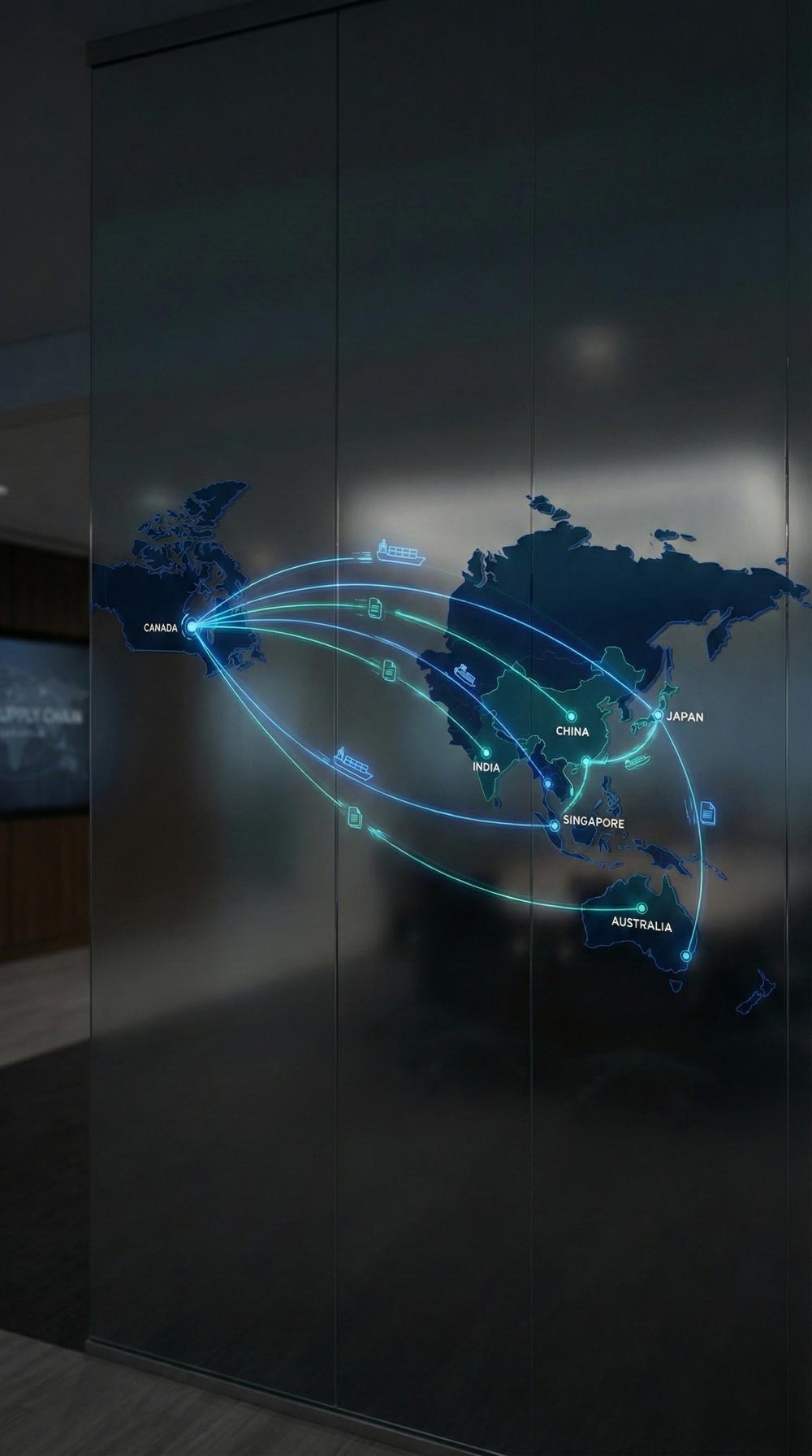
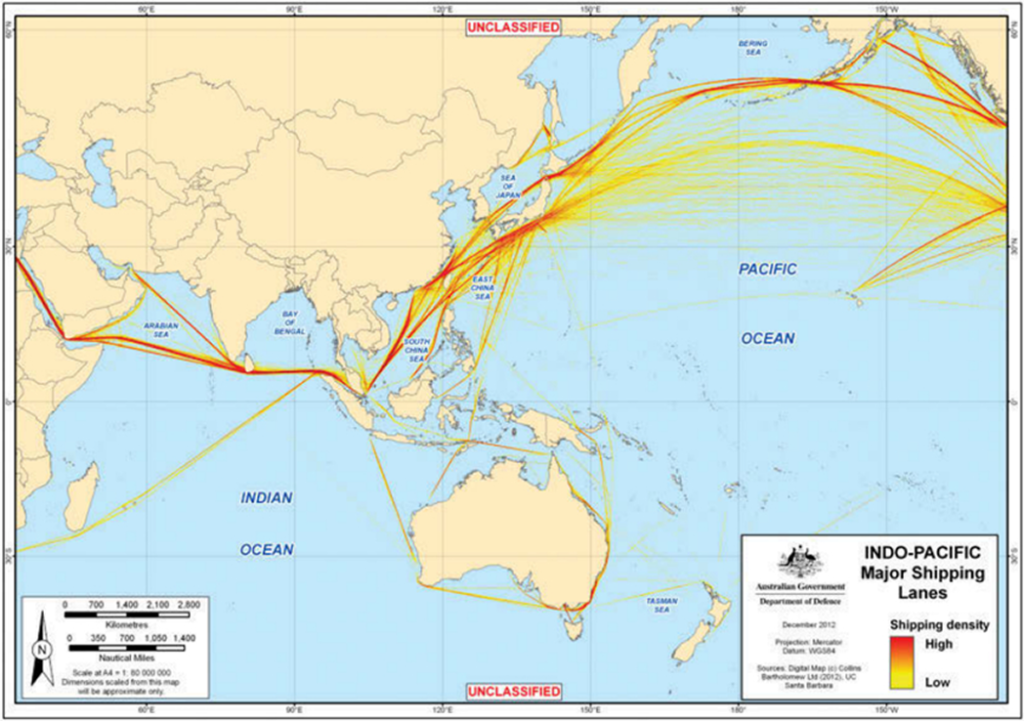
~60% of global maritime trade passes through the Indo‑Pacific (PM briefing book, 2025). The Strait of Malacca is a key oil transit chokepoint linking the Indian and Pacific Oceans (U.S. EIA).
Implication for Canada
Build redundancy in routes, ports, and suppliers — especially for:
The region needs what Canada offers: natural resources managed sustainably, world-class innovation in clean technology, trusted governance and business practices, multicultural expertise and diaspora connections, and stable, reliable partnerships built on shared values.
Indo‑Pacific demand growth is pulling these inputs into batteries, solar, wind, grids and chips.
Risk to manage
Clean-tech manufacturing is highly concentrated: China produces >80% of the world’s battery cells and solar PV modules (ETC, 2025).
Policy move: partner with Indo‑Pacific allies on processing + standards + offtake.
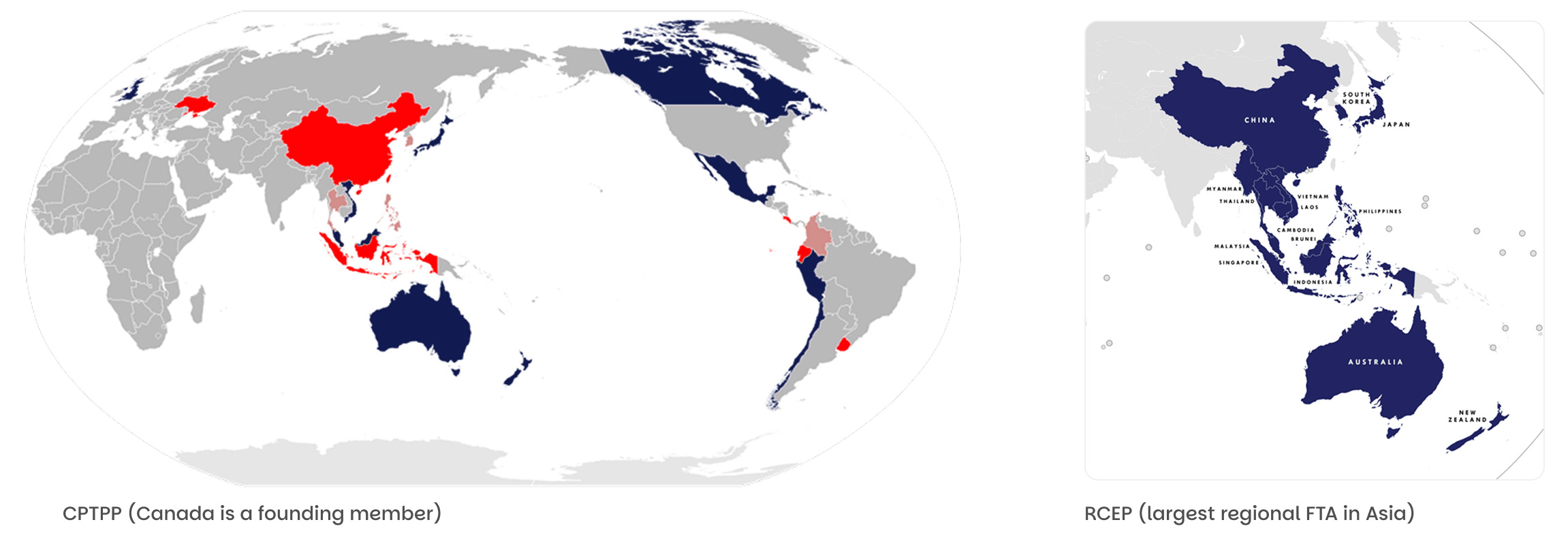
CPTPP scale (2025)
14.7% of global GDP ~590M consumers
Digital standards: DEPA
Canada requested accession
working group established
WTO e‑commerce rules
JSI participants represent
>90% of global trade
The CCIP Network
21 Chambers. One Powerful Network.
CCIP brings together independent Canadian chambers of commerce and business councils operating across the Indo-Pacific region. Our member organizations represent hundreds of Canadian and international enterprises spanning technology, natural resources, financial services, education, infrastructure, and more.
Each chamber maintains its independence while benefiting from collective intelligence, coordinated advocacy, and regionalcollaboration that amplifies Canadian business impact across Asia and the Pacific.
Network Coverage: From established markets like Japan and Singapore to emerging opportunities in Southeast Asia, South Asia, and the Pacific Islands, CCIP members provide on-the-ground presence and expertise across the entire Indo-Pacific landscape.
Governance & Neutrality
Built on Collaboration. Governed by Consensus.
CCIP operates through a unique governance model designed to ensure neutrality, efficiency, and authentic collaboration.
How We’re Governed: The network is collectively led by the Presidents and Chairs of each member chamber. Decisions are made through a consensus-based governance model, ensuring that every member’s voice is heard and valued equally.
Our Operational Model: CCIP operates without full-time staff, corporate funding requirements, or membership dues. This structure ensures operational efficiency, maintains our independence, and keeps focus on collaboration rather than administration.
Why This Matters: Our governance model guarantees that CCIP remains neutral, member-driven, and focused solely on advancing collective Canadian business interests across the Indo-Pacific.
Join / Member Access
Connect With Canada's Indo-Pacific Business Network
CCIP provides member chambers with exclusive access to shared intelligence, operational resources, and collaborative opportunities that strengthen your organization and expand your impact.
For Member Chambers
Access our intelligence platform for market insights, chamber best practices, capacity- building resources, and direct collaboration with fellow chambers across the region.
Select your target market to connect with the appropriate Canadian chamber and access on -the-ground expertise, networking opportunities, and market entry support.